
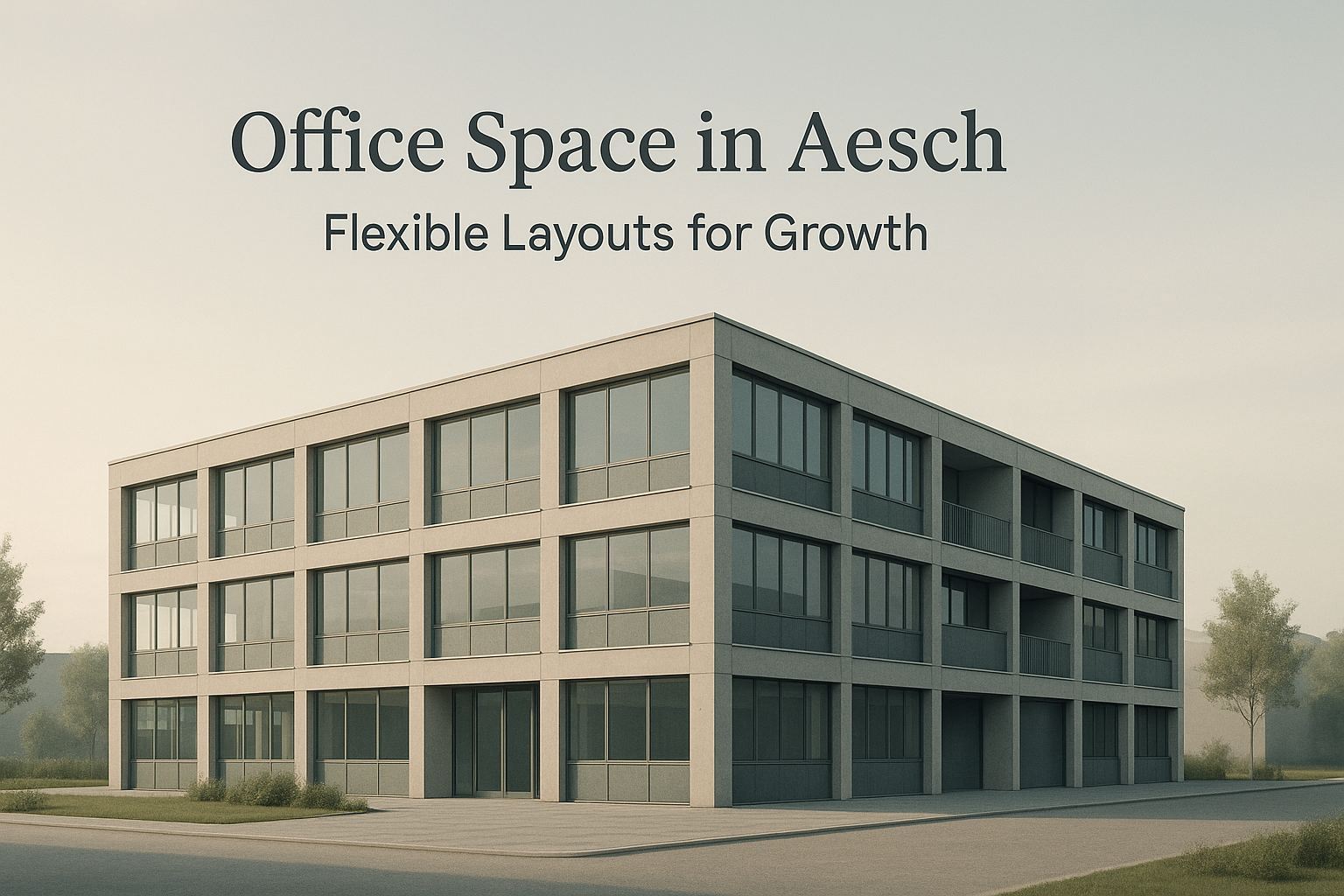
Office Space in Aesch (Asch): Flexible Layouts for Growth in a Hybrid Work Economy
Demand for office space in Aesch (often searched as “office Asch”) increasingly reflects a new reality: companies still value a physical workplace, but they want it to be adaptable, measurable, and efficient. Across Switzerland, as in other developed markets, the workplace is being redesigned around hybrid schedules, variable team attendance, and faster project cycles. That shift changes what “good” looks like in an office rental in Asch: flexibility in layout, infrastructure that supports digital work, and options that allow businesses to scale without locking in the wrong footprint.
Research on the evolving office market shows that offices are not disappearing; rather, they are being treated more like an on-demand utility—activated when collaboration, client work, or team alignment requires it. Modern office planning is increasingly supported by usage metrics, secure access, and strong connectivity to enable ongoing hybrid operations (Agora Real Estate Technologies). In local terms, that means businesses searching for a flexible office in Asch are often looking for more than square meters—they are looking for resilience and operational fit.
Office Rental in Asch: What “Flexible” Means in Practice
“Flexible office space” is frequently used as a marketing term, but for decision-makers it has clear operational implications: the office should provide the right amount of space, in the right configuration, for the right duration. In the framework described by Agora, flexible office space is defined by the ability to give companies “the space they need, where they need it, when they need it, and for as long as they need it” (source).
For an office rental in Asch, flexibility typically shows up in three areas:
- Lease structure flexibility: shorter terms, renewal options, or staged growth clauses that reduce long-term mismatch risk.
- Layout flexibility: spaces that can be reconfigured as headcount changes—e.g., converting open work areas into team rooms or adding meeting capacity without major reconstruction.
- Operational flexibility: the ability to support varying daily attendance—especially for hybrid teams that need fewer fixed desks but more collaboration settings.
This matters in Aesch because many local and regional businesses (professional services, engineering, light industrial administration, healthcare-related services) operate with fluctuating project staffing. A flexible office in Asch can reduce friction when teams expand, consolidate, or rotate between site work and office work.
Large Offices in Asch: Designing for Team Density Without Losing Functionality
Searches for “large offices Asch” often come from established firms that need room for multiple functions: focused work, internal coordination, client meetings, and storage for operational materials. The modern large-office requirement is not necessarily about maximizing desks. It is about supporting multiple work modes—quiet concentration, collaboration, and formal presentation—within one coherent layout.
Evidence from the flexible-office trend points to a growing emphasis on collaborative spaces and technology-driven environments, supported by fast internet and video capabilities to keep hybrid teams integrated (Agora). For larger footprints, this typically translates into:
- Zoned planning: separating quiet work areas from active collaboration zones to reduce internal noise and improve productivity.
- Meeting room strategy: more varied room sizes (2–4 people, 6–10 people, larger boardroom) rather than only one large conference room.
- Hybrid meeting readiness: stable connectivity and video setup as a baseline requirement, not an “IT upgrade later.”
For companies that host clients in Aesch or coordinate with teams in Basel, the Birstal region, or across cantonal borders, large offices perform best when they are planned as operational hubs rather than static desk farms.
Coworking in Asch and Private Flex Suites: When You Need Speed, Not Complexity
Interest in “coworking Asch” is not limited to freelancers. Increasingly, small teams and project groups choose coworking and serviced options because they minimize setup time and allow scaling without long negotiations. Industry research supports this shift: changing work models are creating demand for flexible office space and shorter commitments, while the global coworking market is projected to expand strongly through 2030 (Agora citing Grand View Research).
At the same time, the market is segmenting: some businesses want coworking-style services but still require privacy and clear separation. Metro Manhattan’s analysis of “flexible, private, demised spaces” highlights the movement toward license-like arrangements and shorter renewal cycles, designed to reduce administrative friction (Metro Manhattan Office Space).
In practical terms, coworking in Asch and nearby hubs can support:
- New market entry: teams testing a location before committing to a larger office rental.
- Project staffing: temporary space for a fixed-duration contract or a cross-functional initiative.
- Hybrid “touchdown” patterns: employees who need a professional setting a few days per week.
For modern coworking concepts and design benchmarks, it is useful to look at established models such as the5thfloor.ch, where the workspace is treated as an experience built around productivity, hospitality, and adaptability.
Storage Rooms in Asch: The Missing Component in Office Planning
“Storage rooms Asch” is a high-intent query because storage is often the constraint that makes an otherwise suitable office fail operationally. Many businesses need secure, accessible storage for archives, equipment, promotional materials, tools, or seasonal items. In hybrid environments, storage requirements can actually increase: as desk-sharing grows, employees may need lockers; as meeting rooms increase, so does demand for AV storage and spare furniture.
From a facilities perspective, storage should be evaluated with the same discipline as work areas:
- Security and access control: especially for sensitive files, medical documents, or valuable equipment.
- Logistics and usability: proximity to loading access, elevators, or dedicated service corridors.
- Scalability: the ability to add or reduce storage space as operations change.
For companies considering a commercial property in Asch that combines office and storage, integrating both functions from the beginning can reduce long-term reconfiguration costs.
Technology, Access, and Location: What Employees and Clients Expect in Aesch
Even the best layout underperforms if the location and infrastructure do not support day-to-day work. Research emphasizes that employees want offices that are easy to reach, with good transit, walkable amenities, and nearby restaurants and cafés; remote office parks without services are increasingly unpopular (Agora). In the Aesch context, this means businesses should consider not only the address but also:
- Connectivity: reliable high-speed internet as a baseline for hybrid meetings and cloud workflows.
- Secure access: systems that support flexible attendance and guest management.
- Work environment quality: natural light, ceiling height, and open layouts can materially affect the perceived quality of the office (source).
These factors influence employee retention and client impressions. For service businesses, in particular, the office remains part of the brand experience—even when the team is hybrid.
Commercial Property in Asch: A Long-Term Portfolio View for Businesses
For companies looking beyond a single lease cycle, selecting office space in Aesch is often part of a broader real-estate strategy: keep operational risk low while ensuring enough capacity for growth. Hybrid work adds uncertainty, but it also introduces tools to manage space more accurately. Agora highlights that usage metrics help companies track how often employees come in so they can plan future space needs more rationally (Agora). Over time, this supports a more measured approach to expansion in Asch:
- Plan growth in phases: choose office layouts that can be expanded internally (additional rooms, modular zones) rather than forcing a full relocation.
- Protect optionality: prefer terms and building concepts that allow adjustment as work patterns evolve.
- Align office and operations: if storage rooms in Asch or light logistics are part of the business, integrate them into the site selection criteria early.
Organizations that manage multiple sites often benefit from comparing different commercial projects and concepts. For a wider view of Swiss commercial real estate development and management approaches, it can be helpful to reference a broader portfolio such as sitEX, as well as individual projects like k7bubendorf.ch to understand how mixed-use and business-focused properties are positioned and operated.
Where coworking becomes part of a hybrid footprint strategy—used to supplement a core office rather than replace it—regional operators and platforms can also matter. Depending on team distribution and meeting needs, concepts such as coworking.p201.ch may complement an Aesch headquarters by providing additional flexibility.
Conclusion: A Practical Framework for Choosing Office Space in Aesch (Asch)
Office space in Aesch is increasingly selected for adaptability rather than permanence. Businesses searching for office Asch, large offices Asch, storage rooms Asch, coworking Asch, or commercial property Asch are generally trying to solve the same underlying challenge: how to support growth while keeping operational and financial risk controlled.
A practical selection framework is to evaluate (1) layout flexibility for changing teams, (2) lease and operational flexibility for uncertain attendance patterns, (3) technology readiness for hybrid work, (4) location accessibility and surrounding amenities, and (5) integrated storage and logistics needs. Research indicates that the office remains relevant, but it works best when treated as a flexible utility supported by the right infrastructure and planning discipline (Agora).
With that perspective, an office rental in Asch can become a durable platform: fit for current operations and capable of evolving as your business model, team structure, and customer expectations change over time.