
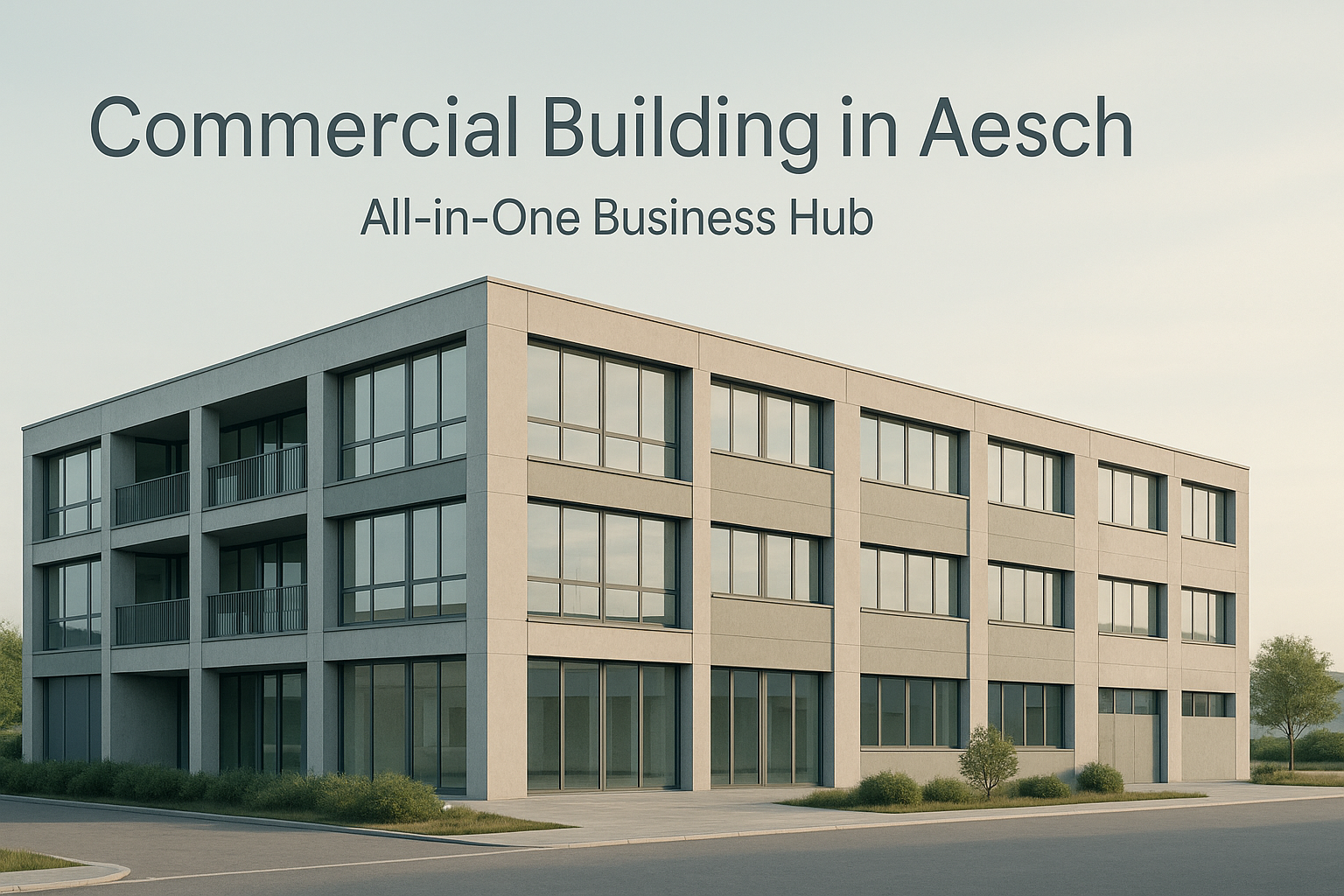
Commercial Building in Asch (Switzerland): An All-in-One Business Hub for Office, Storage, and Coworking
Companies looking for an office in Asch increasingly prioritize practical factors: a location that works for employees and clients, a layout that supports daily operations, and the ability to adapt as the business changes. In that context, a commercial building in Asch that combines private offices, flexible coworking options, and secure storage rooms can function as a true all-in-one business hub—reducing complexity and improving operational continuity.
This article explains how an integrated commercial property in Asch can support different business models (from SMEs to project-based teams), how to assess suitability for large offices in Asch, and why including storage and shared workspace functions in one place can be an advantage over single-use premises. Where relevant, it also situates the Asch building within a broader Swiss real-estate context, including the wider project portfolio of sitEX.
Office Asch: What Businesses Typically Need From a Modern Workspace
Searching for an office Asch is rarely just about square meters. Most organizations evaluate the workspace against a set of operational questions:
- Team structure: Do you need individual rooms, open-plan zones, or a mix?
- Client interaction: Are meeting rooms and a professional setting required for visits?
- Technology readiness: Is the building suited for reliable connectivity and modern AV needs?
- Process efficiency: Can daily routines (deliveries, storage access, quiet work, collaboration) happen without friction?
Business-hub concepts have gained traction internationally because they address these needs through shared infrastructure and flexible space planning. For example, the idea of reservable, technology-enabled meeting and conference space is a common feature in hub models described by external operators such as “The Business Hub” concept, which emphasizes state-of-the-art technology and versatile layouts for modern professional use (Somerset County Business Partnership).
Large Offices Asch: Planning for Growth, Restructuring, and Space Efficiency
Large offices in Asch are most relevant for organizations that need stable capacity—teams that work on site daily, departments that benefit from proximity, or businesses consolidating from multiple smaller locations. The challenge is that “large” does not automatically mean “efficient.”
When assessing a large office setup, decision-makers typically look for:
- Scalable layout options: the ability to rearrange zones as headcount or processes change
- Operational separation: quiet work areas versus collaborative zones
- Meeting capacity: sufficient rooms without overbuilding rarely used areas
- Long-term cost control: reducing the need for frequent moves
A multi-use commercial building can support these goals by offering a core private office footprint plus access to flexible areas (for example, shared meeting rooms or temporary project areas). This approach helps companies maintain a stable base in Asch without committing all space to one fixed use for years.
Storage Rooms Asch: Why On-Site Storage Improves Business Operations
Many businesses underestimate the operational value of secure, accessible storage. Yet demand for storage rooms in Asch is often driven by practical realities: archived documents, tools and equipment, trade materials, seasonal items, e-commerce stock, or marketing collateral that should not occupy prime office space.
Integrating storage within the same commercial property as offices and coworking can improve day-to-day logistics:
- Less wasted office space: storage stays in storage, and offices stay work-focused
- Faster access: inventory or equipment can be retrieved without off-site travel
- Better workflow for hybrid teams: rotating staff still have access to needed materials
- Improved continuity: projects that require physical assets remain manageable even when teams scale up or down
For firms operating in professional services, light production, events, or trade-adjacent sectors, a combined office-and-storage solution in Asch can be materially more efficient than splitting the footprint across separate leases.
Coworking Asch: Flexibility for Project Teams, SMEs, and Hybrid Work
Coworking in Asch is not only for freelancers. In many markets, coworking increasingly supports established companies that need short-term capacity, satellite workspaces, or a professional environment for hybrid teams.
Several widely discussed drivers behind coworking adoption include the need for flexible work environments and the role of coworking spaces in fostering collaboration and productivity (as outlined in broader commentary on innovation and coworking models in business hubs; see Axis Space). The specific geography differs, but the operational logic applies in Switzerland as well: flexible workspaces help organizations respond faster to changes in workload and staffing.
Where a building in Asch offers coworking alongside private offices and storage, typical use cases include:
- New market entry: establishing a presence in Asch without committing to a full-scale long-term office
- Project-based work: providing desks for external specialists or temporary teams
- Hybrid support: offering a stable workplace alternative to home office for part-time on-site staff
- Overflow capacity: expanding during peak periods without relocating the core office
When coworking is part of the same property ecosystem, it can function as a buffer that protects the main lease strategy from day-to-day variability.
For organizations evaluating specific coworking availability and concepts connected to the wider ecosystem, it can be useful to review operational coworking options such as coworking.p201.ch and modern workplace concept references like the5thfloor.ch, particularly when comparing service models, shared infrastructure, and community design.
Commercial Property Asch: Due Diligence That Matters in Multi-Use Buildings
Evaluating a commercial property in Asch that combines office, storage, and coworking functions calls for a slightly different due diligence approach than a single-tenant office. Key points include operational fit, compliance, and long-term flexibility.
1) Building functionality and user mix
Multi-use commercial buildings perform best when the mix of users is compatible. Noise, deliveries, and shared-area usage should be manageable in everyday operations. Businesses should consider how their work patterns align with the building’s operating rhythm.
2) Shared infrastructure and technology readiness
Shared meeting rooms and technology-enabled spaces can reduce the need to build dedicated rooms inside each private unit. International hub examples highlight the value of state-of-the-art technology and hybrid-ready meeting capabilities (Somerset Business Hub). The practical takeaway for Asch: verify the quality of connectivity, meeting-room setup, and the building’s ability to support modern work tools.
3) Safety, governance, and operational transparency
While a Swiss commercial building context is different from historic US labor and safety cases, the broader lesson is that building operations and safety governance matter. Historic analysis of the original Asch Building in New York—later known as the Brown Building—shows how inadequate safety measures (locked doors and insufficient escape routes) contributed to catastrophic outcomes and later regulatory reforms (Cornell ILR / Asch Building landmark documentation). For a modern business hub in Asch, due diligence should include clear emergency procedures, access control principles, and well-defined responsibilities for shared areas.
Practical Business Relevance: Matching Space Types to Real Workflows
An all-in-one business hub in Asch becomes most valuable when companies intentionally match the space types to their workflows:
- Private offices: suitable for leadership teams, confidential work, regulated processes, or client-facing service delivery
- Coworking: effective for flexible staffing, visiting team members, contractors, and agile project work
- Storage rooms: ideal for physical assets and materials that support operations but should not dilute office productivity
Instead of treating “office,” “coworking,” and “storage” as separate real-estate decisions, the building model in Asch allows these components to be managed as one operational footprint—often simplifying internal administration and improving continuity when the business changes.
Long-Term Perspective: Resilience for Changing Space Demand in Asch
Commercial occupancy needs rarely stay constant for a decade. Hiring cycles, strategic shifts, and new service lines affect space requirements. A multi-use building structure can be more resilient because it can support gradual change:
- Downscaling without disruption: keeping a core office while shifting some functions to flexible desks
- Upscaling without relocation: adding capacity through coworking or adjacent units
- Process-driven optimization: moving non-desk functions into storage rooms to protect productive office space
For companies that want to compare how integrated commercial projects are developed and managed in Switzerland, reviewing other initiatives in the same broader market can be helpful. For example, sitEX provides a view into a wider portfolio of commercial real-estate projects (sitEX), and related developments such as k7bubendorf.ch can provide additional reference points when benchmarking location strategy, project positioning, and long-term usability.
Conclusion: A Neutral View on the Role of an All-in-One Commercial Building in Asch
A well-structured commercial building in Asch that combines private offices, coworking, and storage rooms is best understood as an operational tool: it can reduce complexity, support growth or restructuring, and align space usage with real workflows. For organizations comparing options for an office in Asch, especially those needing large offices in Asch or secure storage rooms in Asch, the integrated business-hub model can offer a practical long-term footprint—provided the building’s layout, shared infrastructure, and governance match the way the company actually works.