
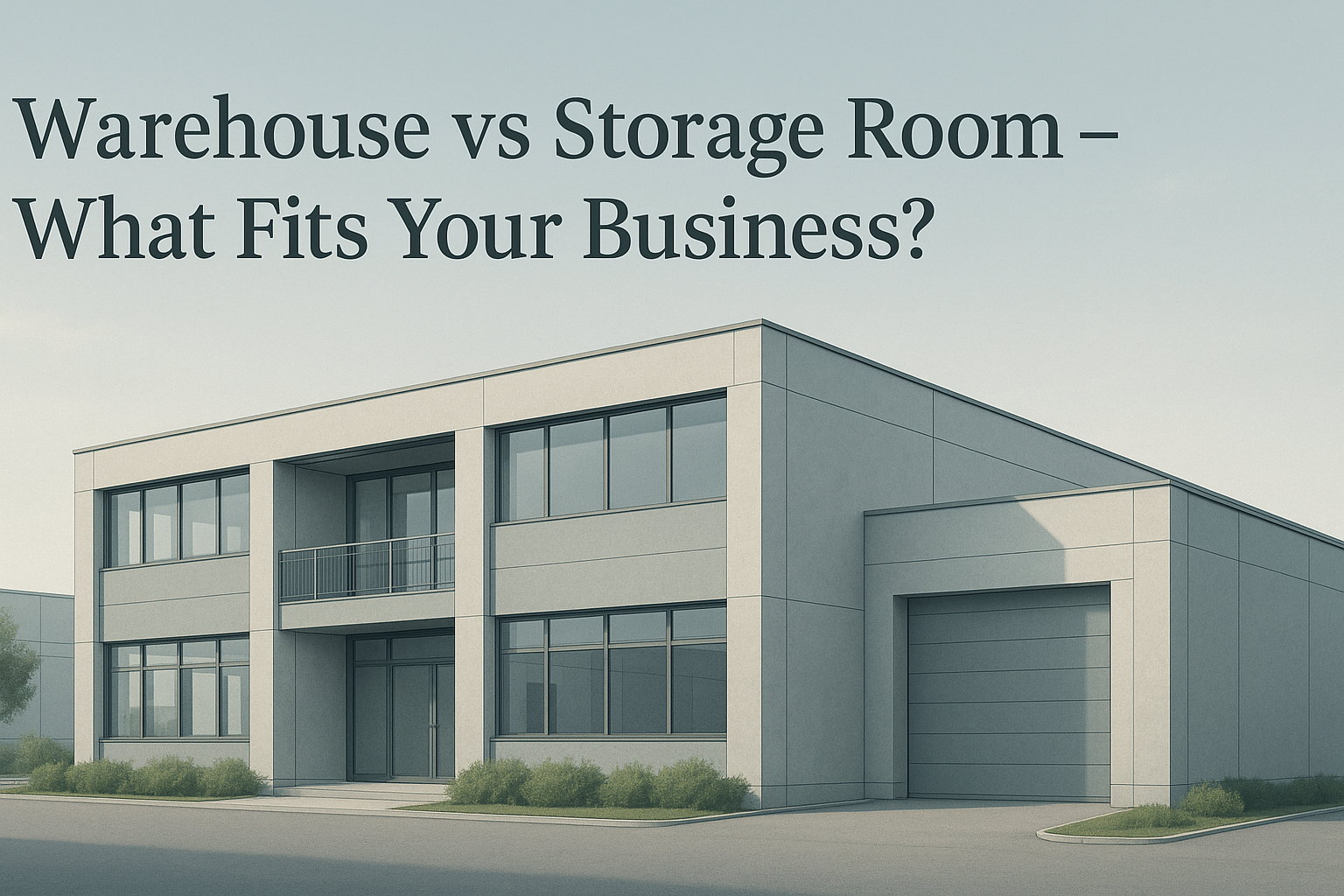
In Asch, businesses often reach a point where growth creates a practical space problem: inventory expands, tools and equipment multiply, archives pile up, and deliveries become more frequent. The question is rarely whether you need more space, but what kind. Should you look for a warehouse in Asch with logistics capability, or is a flexible storage room in Asch enough?
This guide compares warehouse space and storage rooms from an operational point of view. It is written for local decision-makers looking at commercial property in Asch, including businesses that also need an office in Asch, large offices in Asch, or a hybrid setup with coworking in Asch. The goal is to help you choose a storage model that fits today’s workload and still works three years from now.
Warehouse in Asch vs. storage room in Asch: the core difference
The most useful distinction is not size; it is how the space is intended to be used.
A warehouse is typically an active operational environment: goods move in and out frequently, sometimes with structured processes such as receiving, picking, packing, dispatch, and inventory management. Warehouses may be leased privately or run through a third-party logistics provider (3PL) where services are bundled.
A storage room (often comparable to business self-storage) is typically a secure, enclosed unit designed for safekeeping and simpler access. You bring items in, store them, and retrieve them when needed. Service levels are limited by design.
As a general rule, warehousing includes operational services while storage is primarily space. That difference has consequences for cost structure, contract terms, compliance, and day-to-day productivity.
When a storage room in Asch is the better fit
Many small and mid-sized businesses in Asch do not need full warehouse operations. They need reliable space that can flex with project cycles, staffing, and demand. In these cases, a storage room in Asch is often the most efficient option.
Common business use cases for storage rooms
- Contractors and field services: tools, consumables, spare parts, seasonal equipment.
- SMEs with uneven inventory: overflow stock during peaks, packaging supplies, point-of-sale material.
- Professional services: archived documents, marketing materials, event equipment.
- Office moves or fit-outs: temporary storage during renovations or relocations.
For most small businesses, storage rooms tend to win on flexibility and speed of setup. One practical summary is provided by Bolt Storage: self-storage is often cheaper, faster to set up, and easier to scale, while warehouse space brings more overhead and longer commitments (source).
Operational advantages you can plan around
- Contract flexibility: storage is commonly month-to-month rather than multi-year commitments (Bolt Storage overview).
- Scaling up/down: you can adjust unit size as demand changes.
- Lower overhead: typically no staffing, warehouse systems, or service fees.
For businesses in Asch that prioritize predictable costs and operational simplicity, this flexibility can matter more than total square meters.
When a warehouse in Asch makes more sense
A warehouse in Asch becomes more relevant as soon as storage is not just “keeping items” but “running a flow.” If your team ships daily, handles pallets, or requires dedicated receiving/loading routines, warehouse space may reduce friction and improve accuracy.
Typical signs you are outgrowing storage rooms
- High inventory velocity: frequent inbound/outbound movements and tight dispatch windows.
- Pallet-volume goods: racking needs, forklifts, loading docks, truck access.
- Staffed operations: pick/pack processes, QA checks, returns handling.
- Special handling requirements: regulated goods, higher fire-safety requirements, or specific building specifications.
Warehousing decisions are strategic because they affect cost, service levels, and growth capacity. OLIMP Warehousing notes that the right facility choice should start with inventory characteristics, handling needs, and regulatory requirements, then move to location and building specs (source).
What to evaluate beyond “enough space”
- Building and access: loading bays, dock configuration, maneuvering space, and safe circulation.
- Internal layout potential: racking suitability, clear height, and aisle planning.
- Technology and visibility: inventory control systems (if you will run warehouse-style operations).
- Cost model: base rent plus utilities, insurance, maintenance; potentially staffing and equipment.
If you operate at a level where workflow efficiency is the limiting factor, a warehouse can be a long-term productivity investment rather than just a larger storage box.
Cost and commitment: what businesses in Asch should model
Even before viewing properties, it helps to model the cost and commitment differences in a way that matches your business reality.
Storage rooms: simpler costs, simpler risk
Storage room costs are typically straightforward: a monthly rate for a defined unit, usually without long-term contract obligations. Bolt Storage emphasizes that storage often avoids “hidden overhead” and supports fast setup, while warehousing tends to require longer leases and more complexity (source).
Warehouses: more variables, more leverage (if you use them well)
Warehouse costs are rarely just rent. Depending on the model, you may also pay for service fees (3PL), equipment, insurance, utilities, and operational staffing. OLIMP Warehousing highlights how warehousing agreements often include variable and fixed costs, and that longer commitments are common (source).
In practice, the warehouse option becomes financially attractive when it reduces operational friction enough to offset higher fixed costs (fewer shipping errors, faster cycle times, less internal handling, or higher service levels).
How storage decisions connect to office space and coworking in Asch
For many local businesses, storage decisions are linked to workplace strategy. If your administrative team works in an office in Asch while goods and equipment are stored separately, the “right” setup is often a combination: professional office space plus dedicated storage capacity nearby.
Companies looking at large offices in Asch sometimes underestimate the hidden cost of using prime office square meters for low-value storage. Separating functions can improve both productivity and workplace quality: offices remain client-ready and ergonomic, while storage is organized for access and safety.
Similarly, coworking in Asch can be an effective approach for project teams, remote staff, or satellite operations—provided that physical inventory and equipment are handled elsewhere. If you are comparing flexible workspace concepts, it can be useful to look at examples such as coworking.p201.ch and modern formats like the5thfloor.ch to understand how companies separate “workplace” from “storage and operations” in a scalable way.
Choosing the right option: a practical checklist
Use this checklist to decide between a warehouse in Asch and a storage room in Asch based on measurable criteria.
- Access frequency: weekly retrieval favors storage rooms; daily dispatch favors warehouse setups.
- Handling unit: boxes and equipment cases fit storage rooms; pallets and bulk shipments push toward warehouses.
- People and process: if staff will work on-site (picking, packing, QA), a warehouse is typically more appropriate.
- Compliance and restrictions: check what can be stored; many storage models restrict certain categories (food, hazardous materials), while warehouses may support broader requirements.
- Time horizon: short-term uncertainty favors flexible storage; stable volume favors warehouse leases and optimization.
This is also where professional property context matters. If your business anticipates needing different types of space over time—office, storage, and possibly light industrial—it can be useful to understand a broader owner/operator portfolio. For example, sitEX provides an overview of multiple commercial properties and development approaches across Switzerland (sitEX portfolio), and projects such as k7bubendorf.ch illustrate how modern commercial sites can mix functions to support growth phases.
Long-term perspective: planning for growth without locking yourself in
Space decisions in Asch should reflect the business you are becoming, not only today’s constraints. A useful long-term approach is to treat storage as a staged strategy:
- Stage 1: storage room for overflow, documents, tools, or seasonal stock—optimize costs and flexibility.
- Stage 2: expand into larger, more structured storage or mixed commercial property when inventory and access needs increase.
- Stage 3: warehouse space (or a shared 3PL model) when throughput, service levels, and staffing justify an operational facility.
As OLIMP Warehousing notes, facility selection should align with business goals and adapt to future growth (source). For Asch businesses, that often means choosing flexibility early, then investing in warehousing only when operational leverage is clear.
Conclusion: matching the space to the work
The decision between a warehouse in Asch and a storage room in Asch is ultimately about operational intent. If you need secure, flexible, low-overhead capacity for items you access periodically, storage rooms are usually the most appropriate solution. If you need an active site for goods flow, staffed processes, or high-frequency dispatch, warehouse space becomes more relevant.
In both cases, the best outcome comes from viewing storage as part of a broader local footprint: how your office in Asch functions, whether coworking in Asch fits parts of your team, and how your commercial property strategy can scale without creating unnecessary fixed commitments.